


Hey 👋
I’m Oliver Patel, author and creator of Enterprise AI Governance.
Emotion recognition is one of the least understood aspects of the EU AI Act. The prevalence of techniques like sentiment analysis across many industries, combined with the fact that AI-enabled emotion recognition is strictly prohibited in certain EU contexts whilst lawful elsewhere, makes it essential for enterprises to understand the nuances of this prohibition. This article outlines what is prohibited, what is high-risk, and what is not in scope—drawing on the AI Act and the European Commission's guidelines published in February 2025.
This week’s newsletter covers:
✅ Understanding ‘emotion recognition’ under the AI Act
✅ Emotion recognition: what is prohibited?
✅ Is it prohibited? 4-step compliance checklist visual (free download)
✅ Deep-dive on the 4 steps
✅ Emotion recognition: what is high-risk?
✅ Emotion recognition: what is not in scope?
Sign up to secure a 25% discount for my forthcoming book, Fundamentals of AI Governance (2026). It provides a detailed, comprehensive, and visual overview of the EU AI Act, including dozens of flowcharts, checklists, and practical case studies.
Understanding ‘emotion recognition’ under the AI Act
Article 5 of the EU AI Act outlines 8 distinct prohibited AI practices. One of these prohibited AI practices concerns ‘emotion recognition’. Specifically, Article 5(1)(f) prohibits:
“the placing on the market, the putting into service for this specific purpose, or the use of AI systems to infer emotions of a natural person in the areas of workplace and education institutions, except where the use of the AI system is intended to be put in place or into the market for medical or safety reasons”.
The provisions relating to prohibited AI have been applicable since February 2025. This means that since then, it has been prohibited, under EU law, to use AI to infer emotions in the workplace or educational institutions. Regulatory authorities are empowered to investigate and pursue enforcement action in this area. However, we have not yet seen any major cases or actions.
Breaching the provisions on prohibited AI carries a maximum potential fine for companies of up to 7% of global annual turnover. This is the largest potential fine prescribed by the AI Act and greater than any potential fine under the GDPR.
Also, it is worth noting that the European Commission proposals to amend and simplify the AI Act, published in November 2025 and covered extensively on this newsletter, did not propose any changes directly impacting the prohibited AI practices or emotion recognition. Therefore, we can expect relative stability for this area of AI Act compliance.
Considering this, it is important for enterprises to understand exactly what is and what is not prohibited under the AI Act, to facilitate compliant practices and risk-based decision-making.
The prevalence of techniques like sentiment analysis across many industries, and the fact that AI-enabled emotion recognition is strictly prohibited in the EU whilst lawful in other jurisdictions, reinforces the importance of understanding the nuances of emotion recognition and the AI Act.
The analysis that follows outlines what is prohibited, what is high-risk, and what is not in scope.
Emotion recognition: what is prohibited?
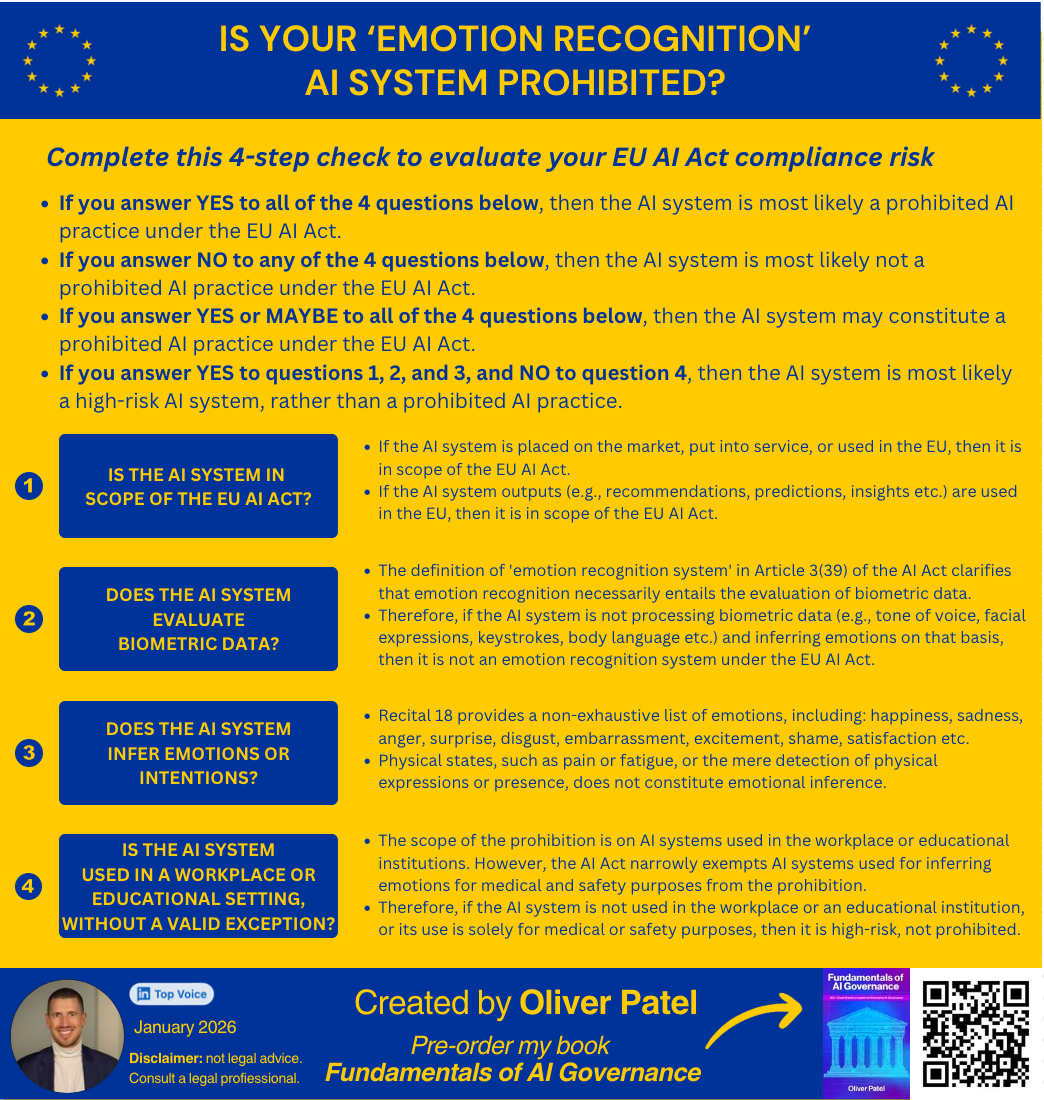
For the use of an AI system for emotion recognition to be prohibited, all four of these conditions must apply simultaneously:
The AI system is in scope of the EU AI Act.
The AI system processes and evaluates biometric data.
The AI system infers emotions.
The AI system is used in the workplace or an educational institution, without a valid exception for medical or safety reasons.
If one or more of these conditions does not apply, then it is most likely not a prohibited AI practice. The only caveat is unless that same AI system is somehow used for another prohibited AI practice (e.g., materially distorting behaviour and causing harm via deceptive, subliminal or manipulative techniques).
Each of these four conditions is equally important and warrant further explanation and analysis.
Check out my visual, 4-step check, which is elaborated on in the analysis below
1. The AI system is in scope of the EU AI Act.
For an AI system to be in scope of the AI Act, it must be placed on the market, put into service, or used in the EU. Also, if the AI system outputs (e.g., recommendations, predictions, insights etc.) are used in the EU, then the AI system is in scope of the AI Act.
Crucially, this means that even if an AI system is not placed on the market, put into service, or used in the EU, it would still be in scope of the AI Act if the outputs of the AI system were used in the EU. This could happen, for example, by sharing AI system outputs to a team based in the EU, for processing, analysis, and decision-making.
The prohibited AI practices apply to all actors under the AI Act. This means that a provider could breach the law by placing a prohibited AI system on the market and a deployer could breach the law by using an AI system in a prohibited manner.
Therefore, the notion of scope (in this context) refers to both territorial scope, as well as what is done (if anything) with the AI system and/or its outputs.
Simply put, if an AI system is developed, made available, and used outside of the EU, and the outputs of that AI system are not transferred to or used in the EU, then it is not in scope of the AI Act and thus cannot be prohibited.
2. The AI system processes and evaluates biometric data.
Article 3(39) defines “emotion recognition system” as:
“an AI system for the purpose of identifying or inferring emotions or intentions of natural persons on the basis of their biometric data”
This means that emotion recognition—as defined by the AI Act— necessarily entails the processing and evaluation of biometric data. If an AI system is not processing biometric data and inferring emotions on that basis, then it is not an emotion recognition system.
Interestingly, some confusion has been caused by the fact that the text of the prohibition itself in Article 5(1)(f) (see above) does not refer to ‘emotion recognition system’ or ‘biometric data’. It merely prohibits the use of AI to “infer emotions [...] in the areas of workplace and education institutions”.
However, in its guidelines, the European Commission acknowledged this discrepancy and clarified that, for consistency reasons, the prohibition should be linked to the legal definition and ‘emotion recognition system’ and thereby limited to “inferences based on a person’s biometric data”. Furthermore, Recital 44 of the AI Act refers to “serious concerns” about using AI systems to infer emotions, due to “limited reliability”, specifically noting that:
“AI systems identifying or inferring emotions or intentions of natural persons on the basis of their biometric data may lead to discriminatory outcomes and can be intrusive to the rights and freedoms of the concerned persons”.
Therefore, if the AI system does not process and evaluate biometric data, and infer emotions on that basis, then it is not an emotion recognition system and is therefore not prohibited.
The notion of “biometric data” is defined in Article 3(34) of the AI Act:
“personal data resulting from specific technical processing relating to the physical, physiological or behavioural characteristics of a natural person, such as facial images or dactyloscopic data”.
This could include physiological biometric data such as fingerprints, iris patterns, and facial structure, or behavioural biometric data such as facial expressions, body language, or tone and pace of voice.
An important caveat to this section’s analysis is that the European Commission guidelines are not legally binding and it is theoretically possible that a member state regulator or a court could interpret the AI Act in a different way. However, considering the legal definition of ‘emotion recognition system’, the wording of Recital 44, and the European Commission guidelines, this would be somewhat surprising.
3. The AI system infers emotions or intentions.
Just because an AI system is evaluating biometric data does not necessarily mean it is inferring emotions. At the risk of stating the obvious, the AI system must infer emotions to be prohibited.
The AI Act does not provide a definition of “emotion”. However, Recital 18 provides a non-exhaustive list of emotions and intentions, for illustrative purposes:
happiness, sadness, anger, surprise, disgust, embarrassment, excitement, shame, contempt, satisfaction, and amusement.
The same recital also clarifies that “physical states, such as pain or fatigue” should not be considered as emotions or intentions. Also, the mere detection of physical expressions (e.g., whether someone is smiling) or presence (e.g., whether someone is in a meeting) does not constitute emotion inference.
The example provided in the AI Act is that using AI to detect the fatigue of professional pilots or drivers, for the purpose of preventing accidents, would not be prohibited.
However, the European Commission guidelines advise that the concept of emotions and intentions should be “understood in a wide sense and not interpreted restrictively”. Therefore, organisations should err on the side of caution when determining whether something is an emotion or not—especially if it is borderline.
Finally, given that AI systems that infer the intentions of individuals are also defined as emotion recognition systems, the European Commission guidelines clarifies that inferring intentions is also in scope of the prohibition.
4. The AI system is used in the workplace or an educational institution, without a valid exception.
Finally, the scope of the prohibition is limited to AI systems used in the workplace or an educational institution.
But not all uses of emotion recognition AI systems in the workplace and education are outright prohibited. The AI Act narrowly exempts AI systems used for inferring emotions for medical and safety purposes from the prohibition.
The European Commission guidelines clarify that the “notion of ‘workplace’ should be interpreted broadly” and includes “any setting where work is performed”. It also covers recruitment and hiring processes and therefore not only employees.
Interestingly, the guidelines provide these two use cases as examples of AI practices that are not prohibited:
“Using voice recognition systems by a call centre to track their customers emotions, such as anger or impatience, is not prohibited by Article 5(1)(f) AI Act (for example to help the employees cope with certain angry customers)”.
If only deployed for personal training purposes, emotion recognition systems are allowed if the results are not shared with HR responsible persons and cannot impact the assessment, promotion etc. of the person trained, provided that the prohibition is not circumvented and the use of the emotion recognition system does not have any impact on the work relationship.
Although it feels counterintuitive, the thinking here is probably that such activities and usage patterns are not relevant for the power imbalances and asymmetries in workplace contexts, such as between employers and employees, self-employed workers, and job candidates.
Crucially, there are two exceptions to the prohibition of emotion recognition in the workplace and educational institutions:
AI systems used for medical reasons.
AI systems used for safety reasons.
This means that, if the use of the AI system for emotion recognition in a workplace context is for medical or safety reasons, then it may be permissible under the AI Act. However, these exceptions should be interpreted narrowly and there is a high bar to reach them.
With respect to medical reasons, the guidelines clarify that this would include approved medical devices, rather than the use of AI to analyse wellbeing more broadly.
With respect to “safety reasons”, the guidelines clarify that this should be interpreted as only applying to protection of life and health, not protection against other risks, like theft or fraud.
Emotion recognition: what is high-risk?
First, let’s recap on what makes an emotion recognition system prohibited:
The AI system is in scope of the EU AI Act.
The AI system processes and evaluates biometric data.
The AI system infers emotions.
The AI system is used in the workplace or an educational institution, without a valid exception for medical or safety reasons.
As explained above, if all four of these conditions apply simultaneously, then the AI system is most likely prohibited under the EU AI Act. However, if only conditions 1, 2, and 3 apply, then the AI system is most likely a high-risk AI system under the AI Act, rather than a prohibited AI practice.
This is because 1) it is in scope of the AI Act, 2) it evaluates biometric data, 3) it infers emotions, but 4) it is not used in a workplace or educational institution, or it is but there is a valid exception in place.
Simply put, if an AI system is used for emotion recognition in a manner that is not prohibited—such as in the workplace and educational institutions for medical or safety reasons, or outside of the workplace and educational institutions altogether—then it would be a high-risk AI system.
Or to put it even more simply, if an AI system used for emotion recognition is not prohibited, it is a high-risk AI system.
For this reason, Annex III(1)(c) of the AI Act includes “AI systems intended to be used for emotion recognition” in the list of high-risk AI systems.
In such scenarios, providers must adhere to the obligations and requirements for the high-risk AI system intended to be used for emotion recognition and deployers must also adhere to the applicable obligations for high-risk AI systems.
Finally, emotion recognition systems are also ‘transparency-requiring’. Article 50(3) of the AI Act stipulates that deployers of emotion recognition systems must inform impacted individuals about the use of the AI system. The only exception to this is for emotion recognition systems used in certain law enforcement contexts.
Emotion recognition: what is not in scope?
Inferring emotion or sentiment merely on the basis of text (i.e., transcript data of what someone said) is not a prohibited AI practice. This was confirmed by the European Commission in its guidelines, which stated:
“An AI system inferring emotions from written text (content/sentiment analyses) to define the style or the tone of a certain article is not based on biometric data and therefore does not fall within the scope of the prohibition.”
Therefore, sentiment analysis, based purely on text transcripts, is not emotion recognition as it is not based on evaluation of biometric data. To further mitigate risk in such scenarios, it is prudent to ensure that text-based transcript data is not enriched with information describing an individual’s behaviour, physical appearance, or physiology.
However, just because text-based sentiment analysis is not emotion recognition and thus not prohibited in this context, does not mean it is always out of scope of the AI Act. It is theoretically possible for sentiment analysis to be part of a high-risk AI system or an alternative prohibited AI practice. For example, if sentiment analysis is embedded within a recruitment screening tool that evaluates candidates’ written responses, the overall AI system would likely be classified as high-risk.
Key takeaways for enterprises
Interpret broadly at this stage. The law is new, enforcement is yet to materialise, and regulatory expectations are still forming. Until we see how regulators and courts apply these provisions in practice, a cautious and expansive interpretation is prudent.
For example, the European Commission guidelines advise that emotions and intentions should be “understood in a wide sense and not interpreted restrictively”. If an AI system evaluates traits closely linked to emotions, treat it as potentially in scope, or at the very least implement additional guardrails.
Determine your global compliance strategy. Will you prohibit AI-enabled emotion recognition activities globally, or only in the EU? A global policy offers simplicity, standardisation, and a higher bar, whereas jurisdiction-specific policies potentially offer more flexibility and agility, albeit with greater compliance spill-over risk. If you do follow a jurisdiction-specific approach, robust controls and guardrails are required to ensure that any AI use cases that would be prohibited in the EU do not inadvertently impact EU-based individuals and that the corresponding AI system outputs are not shared with, or used by, anyone in the EU.
Carefully assess AI applications that evaluate individuals. Any AI system that analyses individuals (e.g., employees or students)—and in particular that evaluates their performance or behaviour in interactions, role-plays, meetings, or interviews—warrants in-depth AI governance review.